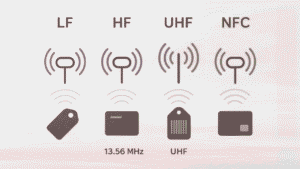
Stop Guessing RFID Frequencies: Pick the Right One (LF, HF, UHF, NFC)
Get the physics, standards, read zone, and tag form factor right—so your system remains reliable at scale.
Facebook
LinkedIn
WhatsApp
Stop Guessing RFID Frequencies: Pick the Right One (LF, HF, UHF, NFC)
If you’ve been asked to “pick an RFID frequency,” you’re usually being asked something broader: choose the physics, the standards, the read zone, and the tag form factor that will make the system reliable at scale.
The problem is that teams often start with the label (LF vs HF vs UHF vs NFC) instead of the constraints that actually decide the outcome: read distance, tag population, material environment (metal/liquid), global regulations, and how tightly you need to control the read zone.
This guide is written for engineers and technical specifiers who are already in decision mode. You’ll get a practical selection flow, a matrix you can drop into a spec, and the failure modes that commonly show up during pilots.
Choose your frequency in 5 questions (decision flow)
Answer these in order. Your “best” frequency usually falls out quickly.
1. How far do you need to read, and how tightly controlled is the read zone?
Tap / intentional read (centimeters) → NFC or HF proximity (often ISO/IEC 14443)
Close range, controlled point reads (centimeters to tens of centimeters) → LF or HF
Meters of range, portals, conveyors, fast reads at scale → UHF (often RAIN RFID / EPC Gen2)
2. How many tags are in the field at once?
One at a time (badge, tool checkout, authentication) → LF/HF/NFC are often easier to control
Dozens to hundreds (cartons, totes, pallets) → UHF is built for high-throughput, multi-tag environments
3. What are the tags attached to (materials + mounting reality)?
Metal-dense environment (racks, bins, fixtures, automotive parts) → you may need LF/HF or specialized UHF on-metal designs plus careful placement
High water content / liquids nearby (beverages, chemicals, people, some medical contexts) → UHF performance can degrade; validate early
4. Where will the system be deployed (regions + compliance)?
If you’ll deploy globally, the UHF band is not “one size fits all.” Your reader configuration has to match local regulations.
5. What does “success” look like in your process?
If your KPI is inventory throughput and cycle counting, UHF often wins.
If your KPI is controlled identification at a specific point, LF/HF/NFC may reduce false reads.
Pro Tip: Treat frequency selection as a system design decision, not a tag-shopping decision. Readers, antennas, mounting, and SOPs will make or break read accuracy.
RFID frequency selection: what actually changes for your design
RFID frequency labels are shorthand for a set of tradeoffs. One of the most useful first principles is whether the system is primarily near-field (inductive) or far-field (backscatter).
LF and HF are typically discussed as inductive, near-field systems (shorter range, more controlled fields).
UHF for supply chain is commonly far-field backscatter (longer range, faster reading at scale).
For terminology clarity around “UHF vs RAIN vs EPC Gen2,” Voyantic’s explainer is one of the clearest: Voyantic’s breakdown of “RAIN RFID” vs “UHF RFID” vs “EPC Gen2 / ISO 18000-63” (and why specs should name both band and protocol).
LF (Low Frequency): proximity reads in difficult materials
Typical fit: short-range identification where the environment is punishing or the read zone must be tight.
Where engineers choose LF:
Tool / fixture identification in metal-heavy work cells
Industrial assets where close-range reads are acceptable
Certain access-control and automotive applications where you want proximity by design
Why LF works (in practice):
Short read ranges reduce unintended reads.
Near-field behavior can be easier to manage when you’re close to metal and when tags are embedded or protected.
Where LF disappoints:
High-throughput, bulk reading of many tags in motion.
Long read distances.
HF (13.56 MHz): controlled reads with richer interaction
HF (13.56 MHz) is often the middle ground: more capability and data interaction than LF, but usually with a controlled read zone.
Typical fit:
Work-in-process checkpoints where you can control orientation and distance
Asset management where you want more intentional reads
Cards, tickets, and secure identification (depending on standard)
Pepperl+Fuchs summarizes the practical framing well, especially on how range and environment push you toward one band or another: Pepperl+Fuchs’ overview of when to choose LF vs HF vs UHF RFID.
UHF (often RAIN RFID / EPC Gen2): long-range, high-throughput identification
If your system goal is to identify many items quickly—and you can design your read zones intentionally—UHF is usually the default.
Typical fit:
Warehouse portals (dock doors), conveyors, sortation
Pallet/case tracking
Retail item-level inventory and cycle counts
In many real-world deployments, UHF means the ecosystem commonly called RAIN RFID, using EPC Gen2 / ISO/IEC 18000-63 (see the Voyantic terminology clarification above).
Where UHF disappoints:
Very tight read zones in cluttered RF environments.
Items with high water content or close proximity to liquids.
Metal adjacency without a tag/placement strategy.
NFC vs RFID (HF): HF optimized for “tap” and smartphone interaction
NFC isn’t “another frequency” so much as a subset of HF (13.56 MHz) optimized for short-range, deliberate interactions (for example, phone tap use cases).
If you need to explain NFC vs RFID (and where NFC fits inside HF), GS1 US has a straightforward primer: GS1’s explanation of RFID vs NFC.
Choose NFC when:
You need smartphone compatibility.
You want extremely short range for intentional reads.
You need a user-centric interaction (tap-to-authenticate, tap-to-check-in).
Don’t choose NFC when:
Your requirement is bulk read throughput.
Your requirement is meters of read range.
Standards & interoperability: what to write in the spec
Teams lose time in RFPs when they specify only “UHF tags” or “HF cards.” That isn’t enough to ensure interoperability.
At minimum, your spec should state:
1. Frequency band (e.g., HF 13.56 MHz; UHF band appropriate to deployment region)
2.Protocol / standard family
UHF supply chain: often EPC Gen2 / ISO/IEC 18000-63 (RAIN RFID ecosystem)
HF: proximity vs vicinity behavior depends on the standard family used
3.Memory needs (Do you need only an ID, or do you need to store additional data?)
4.Security needs (access control and authentication typically require explicit security requirements)
If you’re early in the process, a practical way to avoid over-specifying is to define mandatory compatibility and test acceptance criteria (read rate, accuracy, orientation tolerance) instead of listing every tag micro-feature.
Environment & materials: the part that usually breaks the pilot
Most “RFID doesn’t work” stories aren’t about the frequency choice in isolation. They’re about materials, placement, and uncontrolled read zones.
Metal: manage detuning and reflections with design, not hope
Metal can detune antennas and create reflections. In practice, you handle metal in three ways:
1.Choose a tag design intended for metal adjacency (often “on-metal” hard tags or labels with a built-in spacer structure)
2.Control spacing between the tag antenna and metal when possible
3.Control orientation and read zone geometry
⚠️ Warning: If your item is “sometimes near metal” (automotive parts bins, metal carts, racks), treat it as “always near metal” in the pilot. Partial exposure creates the most confusing failures.
Liquids and high water content: validate early
Liquids and high water content can attenuate RF energy and distort the field, especially for longer-range systems. If your environment includes:
chemical drums
bottled products
wet processes
people-worn tags
…make “wet” a first-class pilot condition.
Heat, chemicals, abrasion: durability is a tag selection criterion
Frequency won’t save a tag that delaminates, cracks, or loses adhesion.
For industrial WIP and automotive contexts, add explicit requirements for:
temperature range
chemical exposure
washdown / IP rating expectations
mechanical abrasion / impact
mounting method (adhesive, rivet, weld-stud, zip tie, embed)
RFID4U has a practical checklist mindset for defining these selection criteria up front: RFID4U’s tag selection criteria guide.
Use-case mapping (what usually wins)
Use cases don’t choose frequencies. Constraints do. Still, these patterns are common.
Manufacturing WIP tracking
Typical constraints:
short-to-medium read distances at defined checkpoints
metal fixtures and tooling nearby
exposure to heat/chemicals
need for high reliability more than maximum range
Common outcomes:
HF can fit when checkpoints are controlled and you need reliable point reads.
UHF can fit when you need faster reads across multiple items (totes, racks), but it demands stricter read zone design and metal/liquid mitigation.
Pilot acceptance tests to run:
read accuracy at the exact checkpoint geometry
false-read rate from adjacent stations
tolerance to orientation variability
Warehouse / logistics and pallets
Typical constraints:
many tags in the field simultaneously
tags moving through portals or along conveyors
need for high throughput
Common outcomes:
UHF is usually the starting point because it’s designed for fast multi-tag reading at distance.
Hidden failure mode:
the system reads too much (uncontrolled read zones). Engineers should design shielding, antenna placement, and timing logic as deliberately as they design the tag.
Apparel & retail inventory
Typical constraints:
large numbers of items
need for rapid cycle counts
handheld and overhead readers
Common outcomes:
UHF is widely used for item-level inventory because it supports fast reads at scale.
A general comparison framing (range and use-case fit) is captured in: LF vs HF vs UHF RFID comparison (ranges, use cases).
Automotive parts tracking
Typical constraints:
metal adjacency everywhere
heat, oils, chemicals, abrasion
long asset life
Common outcomes:
UHF can work with on-metal hard tags and controlled placement.
HF/LF can be attractive for controlled point reads when the environment is extreme and range requirements are modest.
The key is to write acceptance criteria that reflect reality (temperature, chemical exposure, and metal proximity), not lab conditions.
Access control / security
Typical constraints:
intentional reads (you don’t want random reads through a wall)
security requirements
often a “one tag at a time” interaction model
Common outcomes:
NFC/HF proximity is a common fit when you need deliberate, short-range reads and strong ecosystem support.
For a high-level framing of NFC versus broader RFID options, see: NFC vs HF vs UHF RFID differences and typical applications.
Tag form factors & attachment: labels, hard tags, on-metal, embeds
Once you’ve narrowed the frequency, tag selection becomes a mechanical and materials problem.
In your spec, define:
form factor: paper label, PET label, encapsulated hard tag, card, PCB tag
mounting: adhesive type, rivet hole, zip-tie slot, weld-stud mount, embed depth
surface: flat/curved; smooth/textured; painted/oily
print/marking: human-readable text, barcode/2D code, laser marking
Also define operational constraints:
will tags be applied by hand, by applicator, or at a supplier?
will tags be re-used?
what is the expected lifecycle and failure tolerance?
Reader and antenna architecture: portals, handhelds, and embedded stations
Frequency selection can’t be separated from how you’ll interrogate tags.
Common architectures:
1.Portal / dock door: high-throughput, controlled choke point; demands tuning and read-zone control
2.Conveyor / sortation: timing and shielding matter as much as frequency
3.Handheld cycle count: ergonomics and workflow drive ROI; read accuracy depends on operator technique
4.Embedded workstation: controlled geometry; often easier to make reliable
When you can, pick an architecture that reduces ambiguity:
It’s easier to deliver consistent accuracy at a designed checkpoint than in a wide open, uncontrolled space.
Global deployments: UHF regional bands are a real requirement
If you deploy UHF across regions, you’ll run into band and regulation differences. A spec that only says “UHF” is incomplete.
At minimum, document:
countries/regions in scope
compliance expectations for each region
required reader support for region-specific band settings
(For terminology and band range clarity, the Voyantic definition cited earlier is the simplest starting point.)
Pilot plan + KPI checklist (what to validate before scaling)
A short pilot can save months of rework—if it tests the right things.
Define KPIs tied to the process:
cycle count time
pick/pack accuracy
WIP visibility latency
shrink reduction
labor hours saved
Then validate technical acceptance:
read accuracy at each checkpoint geometry
false-read rate and cross-read behavior
performance under worst-case materials (metal/liquid) and worst-case orientation
tag durability under real exposure (heat/chemicals/abrasion)
Finally, validate system acceptance:
integration path to WMS/ERP/MES
exception handling (missed reads, duplicates, rework)
SOP clarity and training needs
RFID tag selection criteria checklist (copy/paste for specs)
The checklist below turns common RFID tag selection criteria into spec-ready requirements you can validate during a pilot.
Copy/paste spec/RFP checklist (engineer-ready)
Use this as a starting point for internal requirements or an RFP.
A) Use case and process
Document which HF standard family is in scope if using HF (e.g., proximity vs vicinity behavior)
What is being tracked (item, tote, carton, pallet, tool, vehicle, person)?
Where are the read points (workstations, portals, conveyors, yards)?
Required read distance range at each read point (min/nominal/max)
Read zone control requirement (tight / moderate / broad)
Tag population in field (typical / worst case)
Motion profile (static / walking / conveyor speed / forklift speed)
B) Environment
Metal proximity (none / occasional / always)
Liquids or high water content nearby (yes/no; describe)
Temperature range and peaks
Chemical exposure (list agents)
Mechanical abrasion/impact
Indoor/outdoor; UV exposure
C) Standards and interoperability
Required band and protocol (e.g., UHF EPC Gen2 / ISO/IEC 18000-63; HF standard family)
Regional deployment scope (US only / global; list countries)
Data format requirements (ID only vs additional memory)
Security requirements (encryption/authentication; access control policies)
D) Tag form factor and attachment
Label vs hard tag vs card vs embedded
Mounting method and surface condition
Required durability and lifecycle
Human-readable + barcode/2D marking requirements
E) Reader/antenna and system
Fixed vs handheld vs embedded stations
Power, network, and mounting constraints
Integration target systems (WMS/ERP/MES) and data flow requirements
Acceptance criteria: accuracy %, false-read rate, throughput targets
FAQ
Is NFC the same as HF RFID?
NFC operates at 13.56 MHz and is generally considered a subset of HF RFID optimized for very short range “tap” interactions and broad smartphone compatibility (see GS1’s explainer linked earlier).
If I need to read pallets at a dock door, should I always choose UHF?
UHF is often the starting point because it supports fast multi-tag reading at distance. But you still need to prove you can control the read zone (avoid cross-reads) and hit accuracy targets under real materials and motion conditions.
If my parts are metal, does that automatically rule out UHF?
Not automatically. It means you must treat tag design and placement as core engineering tasks and validate worst-case configurations early.
What’s the single biggest reason pilots fail?
Treating RFID like a “tag purchase” rather than a system design. Weak read zone design, inconsistent tag placement, and unclear SOPs usually hurt more than the frequency choice.
Next steps
If you’re about to lock a frequency into a spec, do two things first:
1.Document the checklist inputs above (distance, materials, tag population, regions, durability).
2.Run a short pilot that includes your worst-case materials and your real process geometry—then write acceptance criteria based on what the pilot proves.
High-efficiency upgrades across all industries begin with RFID. We look forward to creating the future with you!
info@makarfid.com